CLIMATE CHANGE NOTIFICATION THROUGH PRIORITY-ROUTING NETWORKS USING IOT DEVICES: A STATISTICAL FRAMEWORK FOR REAL-TIME ENVIRONMENTAL MONITORING AND EARLY WARNING
DOI:
https://doi.org/10.71146/kjmr985Keywords:
climate change, Internet of Things, Priority Routing, Environmental Monitoring, Early Warning System, IoT Networks, Statistical Disaster Management, Smart CitiesAbstract
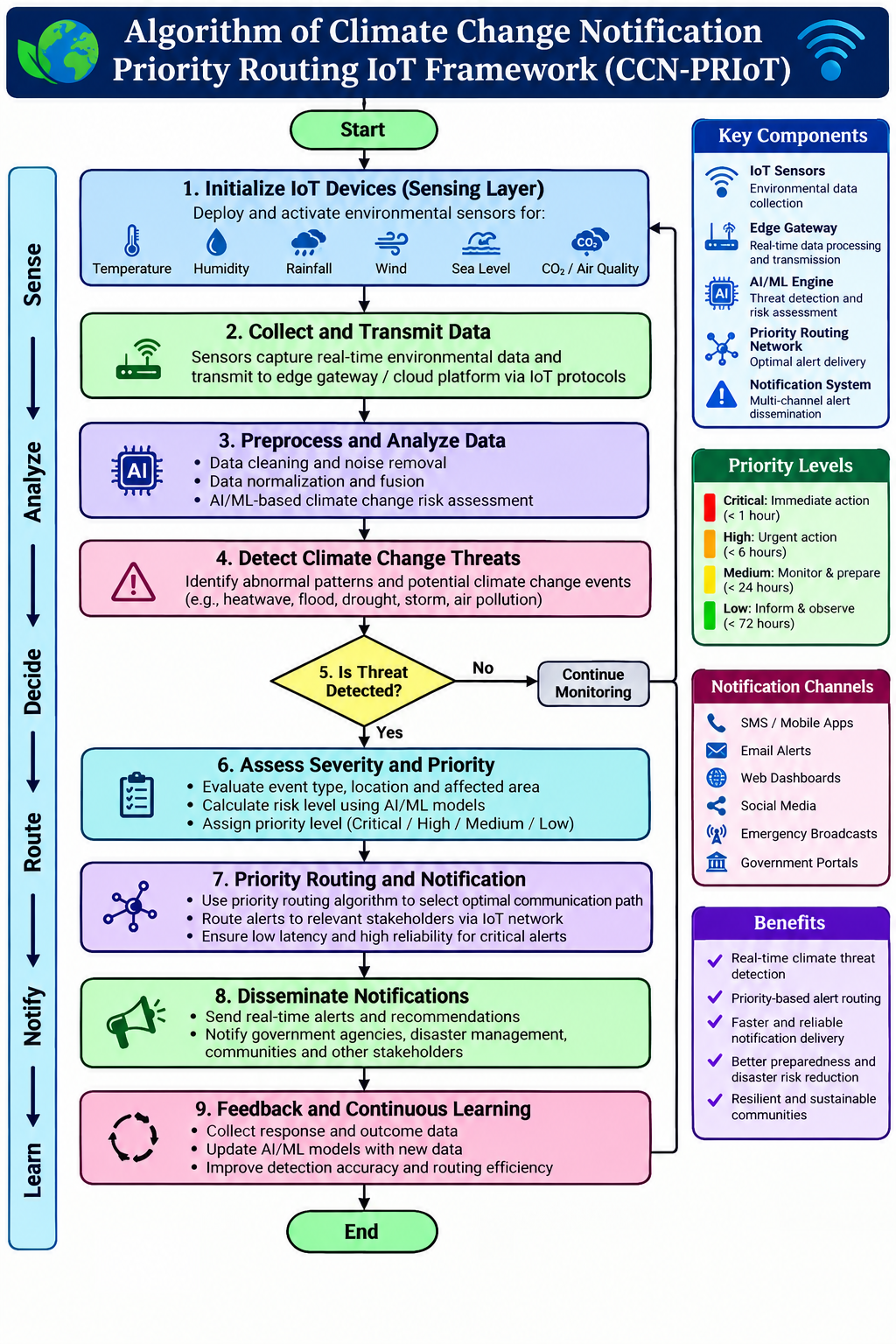
Climate change has increased the frequency and severity of environmental hazards, including floods, droughts, heatwaves, storms, and abnormal weather conditions. Conventional environmental monitoring and communication systems may experience network congestion and delayed transmission during critical events, reducing the effectiveness of early-warning mechanisms. This paper proposes a Climate Change Notification through Priority-Routing IoT Devices (CCN-PRIoT) framework for real-time environmental monitoring, intelligent event classification, and rapid emergency notification. The proposed system integrates distributed Internet of Things (IoT) sensors for collecting environmental parameters, including temperature, humidity, rainfall, atmospheric pressure, wind speed, water level, and air quality. The collected data are processed at edge or cloud nodes to detect abnormal environmental patterns and estimate climate-related risk levels. Based on event severity, urgency, location, and potential impact, a priority score is assigned to each notification. A priority-routing mechanism then selects communication paths that minimize delay and maximize reliability for high-priority alerts. Critical notifications are transmitted before routine monitoring traffic, allowing emergency information to reach disaster management authorities and affected communities more efficiently. The proposed framework supports multi-hop IoT networks, wireless sensor networks, edge computing, and cloud-based analytics. A performance evaluation model is developed using latency, packet delivery ratio, energy consumption, throughput, and priority-based notification success as key performance indicators. The framework can contribute to smart-city climate resilience and disaster risk reduction by improving the speed, reliability, and intelligence of environmental early-warning systems.
Downloads
References
1. Akyildiz, I. F., Su, W., Sankarasubramaniam, Y., & Cayirci, E. (2002). Wireless sensor networks: A survey. Computer Networks, 38(4), 393–422.
2. Gubbi, J., Buyya, R., Marusic, S., & Palaniswami, M. (2013). Internet of Things (IoT): A vision, architectural elements, and future directions. Future Generation Computer Systems, 29(7), 1645–1660.
3. Al-Fuqaha, A., Guizani, M., Mohammadi, M., Aledhari, M., & Ayyash, M. (2015). Internet of Things: A survey on enabling technologies, protocols, and applications. IEEE Communications Surveys & Tutorials, 17(4), 2347–2376.
4. Zanella, A., Bui, N., Castellani, A., Vangelista, L., & Zorzi, M. (2014). Internet of Things for smart cities. IEEE Internet of Things Journal, 1(1), 22–32.
5. Roman, R., Zhou, J., & Lopez, J. (2013). On the features and challenges of security and privacy in distributed Internet of Things. Computer Networks, 57(10), 2266–2279.
6. Shi, W., Cao, J., Zhang, Q., Li, Y., & Xu, L. (2016). Edge computing: Vision and challenges. IEEE Internet of Things Journal, 3(5), 637–646.
7. IPCC. (2023). Climate Change 2023: Synthesis Report. Intergovernmental Panel on Climate Change.
8. UNDRR. (2022). Global Assessment Report on Disaster Risk Reduction. United Nations Office for Disaster Risk Reduction.
Downloads
Published
Issue
Section
Categories
License
Copyright (c) 2026 Dr Anum Ali, Dr Muhammad Hussain (Author)

This work is licensed under a Creative Commons Attribution 4.0 International License.
How to Cite