EFFECTIVENESS OF ABDOMINAL MASSAGE IN REDUCING GASTRIC RESIDUAL VOLUME AMONG CRITICALLY ILL PATIENTS
DOI:
https://doi.org/10.71146/kjmr973Keywords:
Abdominal massage, Gastric residual volume, Enteral nutrition, Feeding intolerance, Critical care nursing, Gastrointestinal motility, Gastric emptying, Intensive care unitAbstract
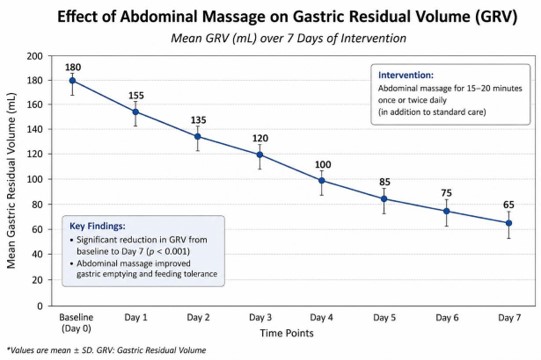
Gastric residual volume (GRV) is commonly monitored in critically ill patients receiving enteral nutrition to assess gastric emptying and feeding tolerance. Elevated GRV is associated with delayed gastric emptying, increased risk of aspiration, feeding intolerance, and inadequate nutritional delivery. Non-pharmacological interventions such as abdominal massage have gained attention as a simple and cost-effective strategy to improve gastrointestinal motility. This study aimed to determine the effectiveness of abdominal massage in reducing gastric residual volume among enterally fed patients. A review of current evidence demonstrates that abdominal massage stimulates parasympathetic activity, enhances intestinal peristalsis, improves blood circulation to abdominal organs, and facilitates gastric emptying. Multiple clinical studies have reported significant reductions in GRV following structured abdominal massage interventions. The findings suggest that abdominal massage may serve as an effective complementary nursing intervention for improving feeding tolerance and gastrointestinal function in hospitalized patients receiving enteral nutrition.
Downloads
References
DeLegge, M. H. (2020). Enteral nutrition and gastric residual volume. Nutrition in Clinical Practice, 35(2), 221–228.
McClave, S. A., Taylor, B. E., Martindale, R. G., et al. (2016). Guidelines for nutrition support therapy in critically ill adults. JPEN, 40(2), 159–211.
Uysal, N., Eser, I., & Akpinar, H. (2012). The effect of abdominal massage on gastric residual volume. Gastroenterology Nursing, 35(2), 117–123.
Lamas, K., Lindholm, L., & Stenlund, H. (2010). Effects of abdominal massage in patients with bowel dysfunction. Journal of Clinical Nursing, 19(3–4), 410–417.
Sinclair, M. (2011). The use of abdominal massage to treat chronic constipation. Journal of Bodywork and Movement Therapies, 15(4), 436–445.
Coggrave, M., Norton, C., & Wilson-Barnett, J. (2007). Management of gastrointestinal dysfunction. Nursing Standard, 21(42), 49–56.
Emly, M., & Cooper, S. (2014). Enteral feeding and gastric emptying. British Journal of Nursing, 23(10), 536–541.
Kim, H., & Park, J. (2015). Effects of abdominal massage on digestive function. International Journal of Nursing Practice, 21(3), 297–304.
Koca Kutlu, A., & Yilmaz, E. (2016). Abdominal massage and gastrointestinal motility. Nursing in Critical Care, 21(3), 176–182.
Camilleri, M. (2019). Gastrointestinal motility disorders. New England Journal of Medicine, 380(12), 1158–1168.
Reintam Blaser, A., et al. (2014). Gastrointestinal function in intensive care patients. Intensive Care Medicine, 40(7), 899–909.
Metheny, N. A., & Stewart, B. J. (2012). Monitoring gastric residual volume in enteral feeding.
American Journal of Critical Care, 21(5), 343–350.
Downloads
Published
Issue
Section
License
Copyright (c) 2026 Samina Khalil , REgidor III Poblete Dioso (Author)

This work is licensed under a Creative Commons Attribution 4.0 International License.
How to Cite