OPTICAL AND ELECTRONIC PROPERTY MODULATION OF NITROGEN-DOPED TIO₂ FOR ENHANCED SOLAR-DRIVEN PHOTOCATALYTIC ACTIVITY
DOI:
https://doi.org/10.71146/kjmr895Keywords:
Nitrogen-doped TiO₂, Photocatalysis, Band gap engineering, Charge carrier dynamicsAbstract
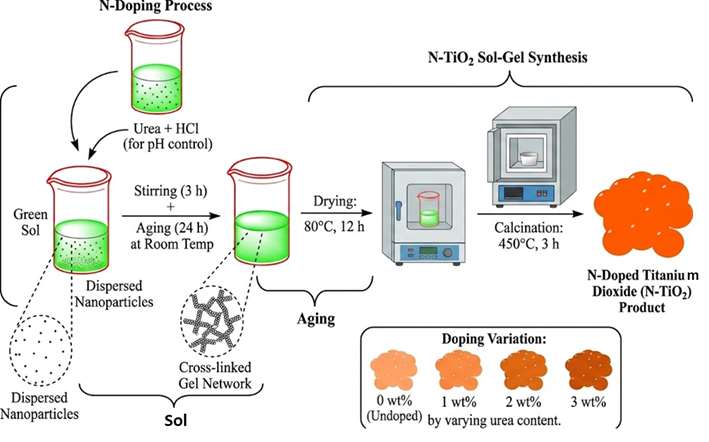
The most common photocatalyst is titanium dioxide (TiO₂). However, its usage is hindered by a wide band gap and fast electron-hole recombination. In this work, nitrogen-doped TiO₂ (N-TiO₂) nanoparticles were prepared via a soul-gel technique modified by varying concentrations of nitrogen. Analysis confirmed the existence of the anatase phase in all samples, and spectroscopic analysis indicated that nitrogen doping had been successfully accomplished. Band gap analysis showed a shift in the absorption edge towards lower energies, thus resulting in narrowing of the band gap and better absorption of visible light. Photoluminescence showed less electron-hole recombination rate, especially when the optimal nitrogen content (1%) was applied. Further, analysis of morphologies proved that porous structures were produced with higher surface area, hence the improvement in photo reactivity. Photocatalytic activity of the N-TiO₂ samples was studied by using methylene blue (MB) degradation in simulated sunlight. It was found that the optimum doping rate was 1%, as it degraded more than 95% of MB within one hour, much higher than pristine TiO₂. Furthermore, the reaction dynamics for N-TiO₂ 1% were significantly faster. Based on mechanistic analysis, it was established that •OH and O₂•⁻ radical anions were major pollutants' degradation pathways.
Downloads
References
Ahmad, N. R. (2025). Digital transformation and competitive advantage: Leveraging AI in emerging market supply chains. Journal of Emerging Technologies and Supply Chain Management, 4(1), 72–86.
Ahmad, N. R. (2025). The impact of fintech startups on financial innovation and stability in Pakistan’s evolving financial landscape. Pakistan Journal of Financial Innovation and Technology, 3(2), 91–105.
[1] S. J. Armaković, M. M. Savanović, and S. Armaković, “Titanium Dioxide as the Most Used Photocatalyst for Water Purification: An Overview,” Catalysts, vol. 13, no. 1, p. 26, Dec. 2022, doi: 10.3390/catal13010026.
[2] S. B. Rawal, S. Bera, D. Lee, D.-J. Jang, and W. I. Lee, “Design of visible-light photocatalysts by coupling of narrow bandgap semiconductors and TiO2: effect of their relative energy band positions on the photocatalytic efficiency,” Catal. Sci. Technol., vol. 3, no. 7, p. 1822, 2013, doi: 10.1039/c3cy00004d.
[3] S. Lettieri, M. Pavone, A. Fioravanti, L. Santamaria Amato, and P. Maddalena, “Charge Carrier Processes and Optical Properties in TiO2 and TiO2-Based Heterojunction Photocatalysts: A Review,” Materials, vol. 14, no. 7, p. 1645, Mar. 2021, doi: 10.3390/ma14071645.
[4] B. Viswanathan and K. R. Krishanmurthy, “Nitrogen Incorporation in TiO 2 : Does It Make a Visible Light Photo-Active Material?” International Journal of Photoenergy, vol. 2012, pp. 1–10, 2012, doi: 10.1155/2012/269654.
[5] N. T. Nolan, D. W. Synnott, M. K. Seery, S. J. Hinder, A. Van Wassenhoven, and S. C. Pillai, “Effect of N-doping on the photocatalytic activity of sol–gel TiO2,” J. Hazard. Mater., vol. 211–212, pp. 88–94, Apr. 2012, doi: 10.1016/j.jhazmat.2011.08.074.
[6] M. Rezapour and N. Talebian, “Comparison of structural, optical properties and photocatalytic activity of ZnO with different morphologies: Effect of synthesis methods and reaction media,” Mater. Chem. Phys., vol. 129, no. 1–2, pp. 249–255, Sep. 2011, doi: 10.1016/j.matchemphys.2011.04.012.
[7] V. Kumaravel et al., “Indium-Doped TiO 2 Photocatalysts with High-Temperature Anatase Stability,” The Journal of Physical Chemistry C, vol. 123, no. 34, pp. 21083–21096, Aug. 2019, doi: 10.1021/acs.jpcc.9b06811.
[8] J. C. Dhar, A. Mondal, S. Bhattacharya, N. K. Singh, C. Ngangbam, and K. K. Chattopadhyay, “Band Gap Tailoring of TiO<SUB>2</SUB> Nanowires by Nitrogen Doping Under N<SUB>2</SUB>/Ar Plasma Environment,” J. Nanosci. Nanotechnol., vol. 15, no. 5, pp. 3951–3955, May 2015, doi: 10.1166/jnn.2015.9502.
[9] R. Asahi, T. Morikawa, T. Ohwaki, K. Aoki, and Y. Taga, “Visible-Light Photocatalysis in Nitrogen-Doped Titanium Oxides,” Science (1979)., vol. 293, no. 5528, pp. 269–271, Jul. 2001, doi: 10.1126/science.1061051.
[10] S. U. M. Khan, M. Al-Shahry, and W. B. Ingler, “Efficient Photochemical Water Splitting by a Chemically Modified n-TiO 2,” Science (1979)., vol. 297, no. 5590, pp. 2243–2245, Sep. 2002, doi: 10.1126/science.1075035.
[11] T. S. Natarajan, V. Mozhiarasi, and R. J. Tayade, “Nitrogen Doped Titanium Dioxide (N-TiO2): Synopsis of Synthesis Methodologies, Doping Mechanisms, Property Evaluation and Visible Light Photocatalytic Applications,” Photochem, vol. 1, no. 3, pp. 371–410, Oct. 2021, doi: 10.3390/photochem1030024.
[12] R. Asahi, T. Morikawa, T. Ohwaki, K. Aoki, and Y. Taga, “Visible-Light Photocatalysis in Nitrogen-Doped Titanium Oxides,” Science (1979)., vol. 293, no. 5528, pp. 269–271, Jul. 2001, doi: 10.1126/science.1061051.
[13] S. K. Kassahun, Z. Kiflie, H. Kim, and A. F. Baye, “Process optimization and kinetics analysis for photocatalytic degradation of emerging contaminant using N-doped TiO2-SiO2 nanoparticle: Artificial Neural Network and Surface Response Methodology approach,” Environ. Technol. Innov., vol. 23, p. 101761, Aug. 2021, doi: 10.1016/j.eti.2021.101761.
[14] N. Khan, K. Tapadia, and C. Thakur, “Application of a novel magnetic Z-scheme heterojunction photocatalyst boron doped-rGO/Fe₂O₃/N-TiO₂ composite for degradation of Rhodamine B dye,” Sustainable Materials and Technologies, vol. 47, p. e01881, Apr. 2026, doi: 10.1016/j.susmat. 2026.e01881.
[15] J. Luo et al., “Direct Attack and Indirect Transfer Mechanisms Dominated by Reactive Oxygen Species for Photocatalytic H 2 O 2 Production on g-C 3 N 4 Possessing Nitrogen Vacancies,” ACS Catal., vol. 11, no. 18, pp. 11440–11450, Sep. 2021, doi: 10.1021/acscatal.1c03103.
[16] J. Ananpattarachai, P. Kajitvichyanukul, and S. Seraphin, “Visible light absorption ability and photocatalytic oxidation activity of various interstitial N-doped TiO2 prepared from different nitrogen dopants,” J. Hazard. Mater., vol. 168, no. 1, pp. 253–261, Aug. 2009, doi: 10.1016/j.jhazmat.2009.02.036.
Downloads
Published
License
Copyright (c) 2026 Faheem Ahmed, Ghulam Qadir Samtio, Ali Bakhsh Jamro, Muzafar Ali Channa, Deedar Ali Jamro, Shahid Ashraf (Author)

This work is licensed under a Creative Commons Attribution 4.0 International License.
How to Cite