AN INTELLIGENT MACHINE LEARNING FRAMEWORK FOR PREDICTING CUSTOMER CHURN AND ENHANCING RETENTION IN SUBSCRIPTION-BASED BUSINESS MODELS
DOI:
https://doi.org/10.71146/kjmr760Keywords:
Customer Churn Prediction, Predictive Analytics, Machine Learning (ML), Subscription-Based Models, Random Forest SMOTE (Synthetic Minority Oversampling Technique), Data Preprocessing, Ensemble Learning, Customer Retention StrategyAbstract
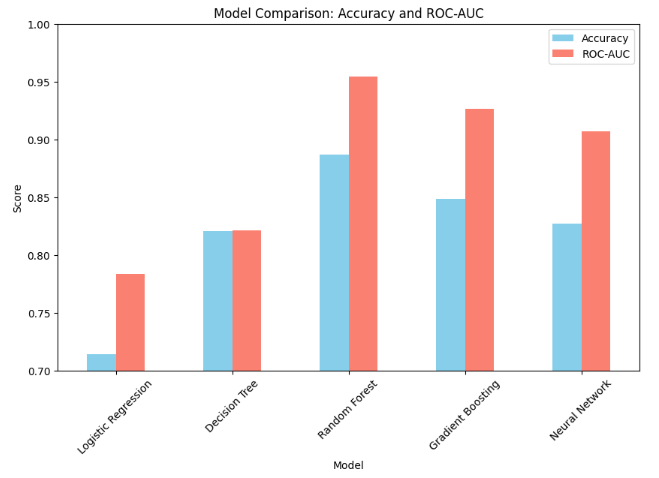
This study presents a machine learning-based framework designed to predict customer churn in subscription-based businesses and help organizations understand why customers discontinue their services. The research investigates the performance of several classification algorithms, including Logistic Regression, Random Forest, and Gradient Boosting, using the dataset obtained from the thesis data. Particular attention is given to data preprocessing and feature engineering, as these steps are essential for improving data quality and developing reliable predictive models. The experimental results demonstrate that ensemble learning techniques deliver the strongest overall performance, achieving an accuracy of 88.7% and a ROC-AUC score of 0.95.
These findings suggest that the proposed approach can effectively distinguish between customers who are likely to remain subscribed and those who may leave the service. The feature importance analysis identifies customer age, active membership status, and the number of products held by each customer as the most influential variables associated with churn. Understanding these factors can help businesses recognize customer behavior patterns and identify potential dissatisfaction at an early stage.
Furthermore, the framework provides valuable insights into the characteristics of customers who are more likely to discontinue their subscriptions. Instead of relying solely on historical reports, organizations can use the model to anticipate possible customer losses and take timely action. For example, businesses may offer personalized incentives, improve customer support, or introduce targeted engagement campaigns for customers identified as being at risk. The integration of predictive analytics into customer relationship management can also support more informed decision-making and improve the allocation of retention resources. Another important aspect of the proposed framework is its potential adaptability to different subscription-based environments, including telecommunications, digital platforms, online services, and membership programs. With appropriate retraining and validation, the model can be updated to reflect changing customer preferences and evolving business conditions. The combination of strong predictive performance and interpretable feature insights makes the framework useful not only for forecasting churn but also for understanding the factors associated with customer departure.
However, the effectiveness of the system in real-world applications will depend on data quality, customer behavior changes, and validation across different business settings. Overall, this research demonstrates how machine learning can transform customer churn analysis from a reactive process into a proactive decision-support mechanism. By identifying at-risk customers earlier and supporting evidence-based retention strategies, the proposed framework can help organizations strengthen customer relationships, improve retention efforts, and increase long-term customer lifetime value.
Downloads
References
1. Khan, M. A., Khan, S. U. R., Rehman, H. U., Aladhadh, S., & Lin, D. (2025). Robust InceptionV3 with Novel EYENET Weights for Di-EYENET Ocular Surface Imaging Dataset: Integrating Chain Foraging and Cyclone Aging Techniques. International Journal of Computational Intelligence Systems, 18(1), 204.
2. Khan, Saif Ur Rehman, Muhammad Nabeel Asim, Sebastian Vollmer, and Andreas Dengel. "FloraSyntropy-net: scalable deep learning with novel FloraSyntropy archive for large-scale plant disease diagnosis." Plant Methods (2026).
3. Bilal, Omair, Arash Hekmat, Inzamam Shahzad, Asif Raza, and Saif Ur Rehman Khan. "Boosting Machine Learning Accuracy for Cardiac Disease Prediction: The Role of Advanced Feature Engineering and Model Optimization." The Review of Socionetwork Strategies (2025): 1-30.
4. Khan, S.U.R., Asif, S., Bilal, O. et al. Lead-cnn: lightweight enhanced dimension reduction convolutional neural network for brain tumor classification. Int. J. Mach. Learn. & Cyber. (2025). https://doi.org/10.1007/s13042-025-02637-6.
5. Khan, S. U. R., Asif, S., Zhao, M., Zou, W., Li, Y., & Xiao, C. (2026). ShallowMRI: A novel lightweight CNN with novel attention mechanism for Multi brain tumor classification in MRI images. Biomedical Signal Processing and Control, 111, 108425.
6. Shahzad, Inzamam, Jianquan Ouyang, and Saif Ur Rehman Khan. "FedVC-ADDiM: a federated learning framework for diagnosis of alzheimer disease using deep learning." Multimedia Systems 32, no. 3 (2026): 161. https://doi.org/10.1007/s00530-026-02229-6
7. Asim, M. N., Ibrahim, M. A., Malik, M. I., Dengel, A., & Ahmed, S. (2022). LGCA-VHPPI: A local-global residue context aware viral-host protein-protein interaction predictor. Plos one, 17(7), e0270275.
8. Ishfaque, Muhammad, Saif Ur Rehman Khan, and Yulong Lou. "Digitizing Health Monitoring in Engineering Structures Using Deep Learning: A Novel Block Architecture for Concrete Crack Prediction in Surface and Sub-surface Dataset." Journal of Bionic Engineering (2026): 1-23.
9. Salahuddin, Abdul Manan Razzaq, Syed Shahid Abbas, Mohsin Ikhlaq, Prince Hamza Shafique, & Inzimam Shahzad. (2024). Development of OWL Structure for Recommending Database Management Systems (DBMS). Journal of Computing & Biomedical Informatics, 7(02).
10. Hekmat, A., et al., Brain tumor diagnosis redefined: Leveraging image fusion for MRI enhancement classification. Biomedical Signal Processing and Control, 2025. 109: p. 108040.
11. Khan, Saif Ur Rehman, Asif Raza, Inzamam Shahzad, and Ghazanfar Ali. "Enhancing concrete and pavement crack prediction through hierarchical feature integration with VGG16 and triple classifier ensemble." In 2024 Horizons of Information Technology and Engineering (HITE), pp. 1-6. IEEE, 2024.
12. Waqas, Muhammad, Zeshan Khan, Shaheer Anjum, and Muhammad Atif Tahir. "Lung-Wise Tuberculosis Analysis and Automatic CT Report Generation with Hybrid Feature and Ensemble Learning." In CLEF (Working notes), pp. 1-10. 2020.
13. Muhammad, N. A., Rehman, A., & Shoaib, U. (2017). Accuracy based feature ranking metric for multi-label text classification. International Journal of Advanced Computer Science and Applications, 8(10).
14. Khan, S. U. R., & Khan, Z. (2025). Detection of Abnormal Cardiac Rhythms Using Feature Fusion Technique with Heart Sound Spectrograms. Journal of Bionic Engineering, 1-20.
15. Waqas, Muhammad, Syed Umaid Ahmed, Muhammad Atif Tahir, Jia Wu, and Rizwan Qureshi. "Exploring multiple instance learning (MIL): A brief survey." Expert Systems with Applications 250 (2024): 123893.
16. Al-Khasawneh, Mahmoud Ahmad, Asif Raza, Saif Ur Rehman Khan, and Zia Khan. "Stock Market Trend Prediction Using Deep Learning Approach." Computational Economics (2024): 1-32
17. Khan, Muhammad Ahmed, Manqiang Peng, Ding Lin, and Saif Ur Rehman Khan. "Deep Learning Based Estimation of Blood Glucose Levels from Multidirectional Scleral Blood Vessel Imaging." arXiv preprint arXiv:2603.12715 (2026).
18. Ur Rehman Khan, Saif, Omair Bilal, Arash Hekmat, Inzamam Shahzad, and Asif Raza. "Advancing food safety: deep learning for accurate detection of bacterial contaminants." Memetic Computing 18, no. 1 (2026): 11.
19. Khan, M.A., Khan, S.U.R. & Lin, D. Shortening surgical time in high myopia treatment: a randomized controlled trial comparing non-OVD and OVD techniques in ICL implantation. BMC Ophthalmol 25, 303 (2025). https://doi.org/10.1186/s12886-025-04135-3
20. Waqas, Muhammad, Muhammad Atif Tahir, Sumaya Al-Maadeed, Ahmed Bouridane, and Jia Wu. "Simultaneous instance pooling and bag representation selection approach for multiple-instance learning (MIL) using vision transformer." Neural Computing and Applications 36, no. 12 (2024): 6659-6680.
21. Hekmat, Arash, Omair Bilal, Zuping Zhang, Saif Ur Rehman Khan, and Sohaib Asif. "FRE-Net: A Fuzzy Richards Functions-Based Ensemble Network for Brain Tumor Detection." Journal of Bionic Engineering (2026): 1-23.
22. Mayumu, Nicanor, Xiaoheng Deng, Antoine Bagula, and Patrick Mukala. "V2X-JEPA: Self-Supervised Multi-Agent Joint Embedding Predictive Architecture for Robust Vehicle-to-Everything Perception." IEEE Internet of Things Journal (2026).
23. Waqas, Muhammad, Muhammad Atif Tahir, and Salman A. Khan. "Robust bag classification approach for multi-instance learning via subspace fuzzy clustering." Expert Systems with Applications 214 (2023): 119113.
24. Khan, Saif Ur Rehman, Muhammad Nabeel Asim, Sebastian Vollmer, and Andreas Dengel. "Temperature-driven robust disease detection in brain and gastrointestinal disorders via context-aware adaptive knowledge distillation." Biomedical Signal Processing and Control 112 (2026): 108671.
25. Khan, S. U. R., Asif, S., Zhao, M., Zou, W., Li, Y., & Xiao, C. (2026). ShallowMRI: A novel lightweight CNN with novel attention mechanism for Multi brain tumor classification in MRI images. Biomedical Signal Processing and Control, 111, 108425.
26. Khan, M. A., Khan, S. U. R., Rehman, H. U., Aladhadh, S., & Lin, D. (2025). Robust InceptionV3 with Novel EYENET Weights for Di-EYENET Ocular Surface Imaging Dataset: Integrating Chain Foraging and Cyclone Aging Techniques. International Journal of Computational Intelligence Systems, 18(1), 1-26.
27. Raza, Salahuddin, S. Latif, and G. Ali, “Refine Security Control Protocols for Block chain in Textile Industry Supply Chain Management”, VFAST trans. softw. eng., vol. 14, no. 2, pp. 62–80, Apr. 2026.
28. Khan, U. S., & Khan, S. U. R. (2025). Ethics by Design: A Lifecycle Framework for Trustworthy AI in Medical Imaging From Transparent Data Governance to Clinically Validated Deployment. arXiv preprint arXiv:2507.04249.
29. Waqas, Muhammad, Muhammad Atif Tahir, and Rizwan Qureshi. "Deep Gaussian mixture model based instance relevance estimation for multiple instance learning applications." Applied intelligence 53, no. 9 (2023): 10310-10325.
30. Khan, S. U. R., Rehman, H. U., & Bilal, O. (2025). AI-powered cancer diagnosis: classifying viable (live) vs non-viable (dead) cells using transfer learning. Signal, Image and Video Processing, 19(15), 1326.
31. Khan, S.U.R., Zhao, M. & Li, Y. Detection of MRI brain tumor using residual skip block based modified MobileNet model. Cluster Comput 28, 248 (2025). https://doi.org/10.1007/s10586-024-04940-3
32. Waqas M, Bandyopadhyay R, Showkatian E, Muneer A, Zafar A, Alvarez FR, Marin MC, Li W, Jaffray D, Haymaker C, Heymach J. The Next Layer: Augmenting Foundation Models with Structure-Preserving and Attention-Guided Learning for Local Patches to Global Context Awareness in Computational Pathology. arXiv preprint arXiv:2508.19914. 2025 Aug 27.
33. Shahzad, Inzamam, Asif Raza, and Muhammad Waqas. "Medical Image Retrieval using Hybrid Features and Advanced Computational Intelligence Techniques." Spectrum of engineering sciences 3, no. 1 (2025): 22-65.
34. CONVOLUTIONAL NEURAL NETWORK ARCHITECTURES FOR ROBUST IMAGE FEATURE REPRESENTATION IN RETRIEVAL SYSTEMS. (2026). Kashf Journal of Multidisciplinary Research, 3(02), 109-139.
35. Bilal, O., Hekmat, A., Shahzad, I. et al. Boosting Machine Learning Accuracy for Cardiac Disease Prediction: The Role of Advanced Feature Engineering and Model Optimization. Rev Socionetwork Strat (2025). https://doi.org/10.1007/s12626-025-00190-w
36. Asif Raza, Inzamam Shahzad, Ghazanfar Ali, and Muhammad Hanif Soomro. "Use Transfer Learning VGG16, Inception, and Reset50 to Classify IoT Challenge in Security Domain via Dataset Bench Mark." Journal of Innovative Computing and Emerging Technologies 5, no. 1 (2025).
37. Khan, Z., Khan, S. U. R., Bilal, O., Raza, A., & Ali, G. (2025, February). Optimizing Cervical Lesion Detection Using Deep Learning with Particle Swarm Optimization. In 2025 6th International Conference on Advancements in Computational Sciences (ICACS) (pp. 1-7). IEEE.
38. Waqas, Muhammd, Muhammad Atif Tahir, and Rizwan Qureshi. "Ensemble-based instance relevance estimation in multiple-instance learning." In 2021 9th European workshop on visual information processing (EUVIP), pp. 1-6. IEEE, 2021.
39. Waqas, Muhammad, Zeshan Khan, Shaheer Anjum, and Muhammad Atif Tahir. "Lung-Wise Tuberculosis Analysis and Automatic CT Report Generation with Hybrid Feature and Ensemble Learning." In CLEF (Working notes), pp. 1-10. 2020.
40. Khan, S. U. R., Asif, S., Zhao, M., Zou, W., & Li, Y. (2025). Optimize brain tumor multiclass classification with manta ray foraging and improved residual block techniques. Multimedia Systems, 31(1), 1-27.
41. Asif Raza, Salahuddin, Ghazanfar Ali, Muhammad Hanif Soomro, Saima Batool, "Analyzing the Impact of Artificial Intelligence on Shaping Consumer Demand in E-Commerce: A Critical Review", International Journal of Information Engineering and Electronic Business(IJIEEB), Vol.17, No.5, pp. 42-61, 2025. DOI:10.5815/ijieeb.2025.05.04
42. Nabeel Asim, M., Ali Ibrahim, M., Fazeel, A., Dengel, A., & Ahmed, S. (2023). Dna-mp: a generalized dna modifications predictor for multiple species based on powerful sequence encoding method. Briefings in Bioinformatics, 24(1), bbac546
43. Raza, Asif, Inzamam Shahzad, Muhammad Salahuddin, and Sadia Latif. "Satellite Imagery Employed to Analyze the Extent of Urban Land Transformation in The Punjab District of Pakistan." Journal of Palestine Ahliya University for Research and Studies 4, no. 2 (2025): 17-36.
44. Khan, S. U. R., Asif, S., Zhao, M., Zou, W., Li, Y., & Li, X. (2025). Optimized deep learning model for comprehensive medical image analysis across multiple modalities. Neurocomputing, 619, 129182.
45. Khan, Saif Ur Rehman, Asif Raza, Inzamam Shahzad, and Shehzad Khan. "Subcellular Structures Classification in Fluorescence Microscopic Images." In International Conference on Computing & Emerging Technologies, pp. 271-286. Cham: Springer Nature Switzerland, 2023.
46. Maqsood, H., & Khan, S. U. R. (2025). MeD-3D: A Multimodal Deep Learning Framework for Precise Recurrence Prediction in Clear Cell Renal Cell Carcinoma (ccRCC). arXiv preprint arXiv:2507.07839.
47. Raza, Asif, Salahuddin, & Inzamam Shahzad. (2024). Residual Learning Model-Based Classification of COVID-19 Using Chest Radiographs. Spectrum of Engineering Sciences, 2(3), 367–396.
48. Khan, S. U. R. (2025). Multi-level feature fusion network for kidney disease detection. Computers in Biology and Medicine, 191, 110214.
49. Abbasi, A. F., Asim, M. N., Ahmed, S., Vollmer, S., & Dengel, A. (2024). Survival prediction landscape: an in-depth systematic literature review on activities, methods, tools, diseases, and databases. Frontiers in Artificial Intelligence, 7, 1428501.
50. Salahuddin, Syed Shahid Abbas, Prince Hamza Shafique, Abdul Manan Razzaq, & Mohsin Ikhlaq. (2024). Enhancing Reliability and Sustainability of Green Communication in Next-Generation Wireless Systems through Energy Harvesting. Journal of Computing & Biomedical Informatics.
51. S. U. R. Khan, A. Raza, I. Shahzad and G. Ali, "Enhancing Concrete and Pavement Crack Prediction through Hierarchical Feature Integration with VGG16 and Triple Classifier Ensemble," 2024 Horizons of Information Technology and Engineering (HITE), Lahore, Pakistan, 2024, pp. 1-6.
52. Mahmood, F., Abbas, K., Raza, A., Khan,M.A., & Khan, P.W. (2019 ). Three Dimensional Agricultural Land Modeling using Unmanned Aerial System (UAS). International Journal of Advanced Computer Science and Applications (IJACSA) [p-ISSN : 2158-107X, e-ISSN : 2156-5570], 10(1).
53. HUSSAIN, S., Raza, A., MEERAN, M. T., IJAZ, H. M., & JAMALI, S. (2020). Domain Ontology Based Similarity and Analysis in Higher Education. IEEEP New Horizons Journal, 102(1), 11-16.
54. Hekmat, A., Zuping, Z., Bilal, O., & Khan, S. U. R. (2025). Differential evolution-driven optimized ensemble network for brain tumor detection. International Journal of Machine Learning and Cybernetics, 1-26.
55. Raza, A., & Meeran, M. T. (2019). Routine of Encryption in Cognitive Radio Network. Mehran University Research Journal of Engineering and Technology [p-ISSN: 0254-7821, e-ISSN: 2413-7219], 38(3), 609-618.
56. Meeran, M. T., Raza, A., & Din, M. (2018). Advancement in GSM Network to Access Cloud Services. Pakistan Journal of Engineering, Technology & Science [ISSN: 2224-2333], 7(1).
57. Bilal, O., Hekmat, A., & Khan, S. U. R. (2025). Automated cervical cancer cell diagnosis via grid search-optimized multi-CNN ensemble networks. Network Modeling Analysis in Health Informatics and Bioinformatics, 14(1), 67.
58. N. Mayumu, X. Deng, A. Bagula, S. u. R. Khan and P. Mukala, "V2X-JEPA: Self-Supervised Multi-Agent Joint Embedding Predictive Architecture for Robust Vehicle-to-Everything Perception," in IEEE Internet of Things Journal, doi: 10.1109/JIOT.2026.3660030.
59. Raza, Asif , Soomro, M. H., Shahzad, I., & Batool, S. (2024). Abstractive Text Summarization for Urdu Language. Journal of Computing & Biomedical Informatics, 7(02).
60. M. Wajid, M. K. Abid, A. Asif Raza, M. Haroon, and A. Q. Mudasar, “Flood Prediction System Using IOT & Artificial Neural Network”, VFAST trans. softw. eng., vol. 12, no. 1, pp. 210–224, Mar. 2024.
61. N. Mayumu, D. Xiaoheng, P. Mukala, S. U. R. Khan and M. U. Saeed, "Omni-V2X: A Vision-Language Model for Actionable Insights in Vehicle-to-Everything Systems," 2025 International Joint Conference on Neural Networks (IJCNN), Rome, Italy, 2025, pp. 1-8, doi: 10.1109/IJCNN64981.2025.11228491.
62. Waqas, M., Vierra, C., Kaplan, D. L., & Othman, S. (2019). Feasibility of low field MRI and proteomics for the analysis of tissue engineered bone. Biomedical Physics & Engineering Express, 5(2), 025037.
63. M. Waqas, Z. Khan, S. U. Ahmed and Asif. Raza, "MIL-Mixer: A Robust Bag Encoding Strategy for Multiple Instance Learning (MIL) using MLP-Mixer," 2023 18th International Conference on Emerging Technologies (ICET), Peshawar, Pakistan, 2023, pp. 22-26.
64. S. ur R. Khan, Asif. Raza, Muhammad Tanveer Meeran, and U. Bilhaj, “Enhancing Breast Cancer Detection through Thermal Imaging and Customized 2D CNN Classifiers”, VFAST trans. softw. eng., vol. 11, no. 4, pp. 80–92, Dec. 2023.
65. Wasim, M., Mahmood, W., Asim, M. N., & Khan, M. U. (2018). Multi-label question classification for factoid and list type questions in biomedical question answering. IEEE Access, 7, 3882-3896.
66. Mehmood, Faiza, Muhammad Usman Ghani, Muhammad Nabeel Asim, Rehab Shahzadi, Aamir Mehmood, and Waqar Mahmood. "MPF-Net: A computational multi-regional solar power forecasting framework." Renewable and Sustainable Energy Reviews 151 (2021): 111559.
67. Yang, H., Khan, S. U. R., Bilal, O., Chen, C., & Zhao, M. (2025). CEOE-Net: Chaotic Evolution Algorithm-Based Optimized Ensemble Framework Enhanced with Dual-Attention for Alzheimer’s Diagnosis. Computer Modeling in Engineering & Sciences, 145(2), 2401.
68. Chomba, B., Mukala, P., Mayumu, N., & Khan, S. U. R. (2025). DynaKG: Dynamic Knowledge Graph Attention With Learnable Temporal Decay for Recommendation. IEEE Access, 13, 216956-216970.
69. Khan, Saif Ur Rehman, Muhammad Nabeel Asim, Sebastian Vollmer, and Andreas Dengel. "FOLC-Net: A federated-optimized lightweight architecture for enhanced MRI disease diagnosis across axial, coronal, and sagittal views." arXiv preprint arXiv:2507.06763 (2025).
70. S. U. R. Khan, A. Raza, I. Shahzad and G. Ali, "Enhancing Concrete and Pavement Crack Prediction through Hierarchical Feature Integration with VGG16 and Triple Classifier Ensemble," 2024 Horizons of Information Technology and Engineering (HITE), Lahore, Pakistan, 2024, pp. 1-6, doi: 10.1109/HITE63532.2024.10777242.
71. Ijaz, M., Khan, S. U. R., Rehman, A. U., Zaib, A., Vollmer, S., Dengel, A., & Asim, M. N. (2026). SolarFCD: A Large-Scale Dataset and Benchmark for Solar Fault Classification in Photovoltaic Systems. arXiv preprint arXiv:2604.23662.
72. Asim, Muhammad Nabeel, Muhammad Ali Ibrahim, Muhammad Imran Malik, Andreas Dengel, and Sheraz Ahmed. "Circ-LocNet: A computational framework for circular RNA sub-cellular localization prediction." International Journal of Molecular Sciences 23, no. 15 (2022): 8221.
73. Ishfaque, M., Khan, S. U. R., & Lou, Y. L. (2026). Towards efficient dam inspection: crack detection via chirplet transform feature and a pruned VGG16 architecture. Memetic Computing, 18(1), 9.
74. Khan, S. U. R., Asim, M. N., Vollmer, S., & Dengel, A. (2025). Dynamic Weight Adjustment for Knowledge Distillation: Leveraging Vision Transformer for High-Accuracy Lung Cancer Detection and Real-Time Deployment. arXiv preprint arXiv:2510.20438.
75. S. Ur Rehman Khan, O. Bilal, S. Mistry, N. Deb, M. Mahmud and M. Bhuyan, "KDLight: A Lightweight Knowledge Distillation Framework for Medical Image Classification," 2025 International Joint Conference on Neural Networks (IJCNN), Rome, Italy, 2025, pp. 1-8, doi: 10.1109/IJCNN64981.2025.11228615.
76. O. Bilal, S. Ur Rehman Khan, S. Mistry, N. Deb, M. Mahmud and M. Bhuyan, "Towards Efficient Pruning and Multi-Scale Feature Transformations to Uncover Medical Diseases," 2025 International Joint Conference on Neural Networks (IJCNN), Rome, Italy, 2025, pp. 1-8, doi: 10.1109/IJCNN64981.2025.11229047.
77. Waqar, I. A., Zaib, A., Ahmed, S., Vollmer, S., Dengel, A., & Asim, M. N. (2026). MS-SSE-Net: A Multi-Scale Spatial Squeeze-and-Excitation Network for Structural Damage Detection in Civil and Geotechnical Engineering. arXiv preprint arXiv:2604.14711.
78. Khan, S. R., Raza, A., Waqas, M., & Raphay Zia, M. A. (2024). Efficient and Accurate Image Classification via Spatial Pyramid Matching and SURF Sparse Coding. Lahore Garrison University Research Journal of Computer Science and Information Technology, 7(4).
79. Stricker, Marco, Muhammad Nabeel Asim, Andreas Dengel, and Sheraz Ahmed. "CircNet: an encoder–decoder-based convolution neural network (CNN) for circular RNA identification." Neural Computing and Applications 34, no. 14 (2022): 11441-11452.
80. Shahzad, Inzamam, Asif Raza, Hasaan Maqsood, Saif Ur Rehman Khan, and Ghazanfar Ali. "Towards Robust Breast Cancer Diagnosis: A Hybrid Deep Learning Ensemble Framework." In 2025 Horizons of Information Technology and Engineering (HITE), pp. 1-6. IEEE, 2025.
81. Waqas, M., & Khan, M. A. (2018). JSOPT: A framework for optimization of JavaScript on web browsers. Mehran University Research Journal of Engineering & Technology, 37(1), 95-104.
82. Ijaz, M., Khan, S. U. R., Rehman, A. U., Asif, T., Vollmer, S., Dengel, A., & Asim, M. N. (2026). GlobalWasteData: A Large-Scale, Integrated Dataset for Robust Waste Classification and Environmental Monitoring. arXiv preprint arXiv:2602.07463.
83. Mehmood, Faiza, Rehab Shahzadi, Hina Ghafoor, Muhammad Nabeel Asim, Muhammad Usman Ghani, Waqar Mahmood, and Andreas Dengel. "EnML: Multi-label ensemble learning for Urdu text classification." ACM Transactions on Asian and Low-Resource Language Information Processing 22, no. 9 (2023): 1-31.
84. Khan, Saif Ur Rehman, Muhammad Nabeel Asim, Sebastian Vollmer, and Andreas Dengel. "Temperature-driven robust disease detection in brain and gastrointestinal disorders via context-aware adaptive knowledge distillation." Biomedical Signal Processing and Control 112 (2026): 108671.
85. Asim, Muhammad Nabeel, Muhammad Ali Ibrahim, Tayyaba Asif, and Andreas Dengel. "RNA sequence analysis landscape: A comprehensive review of task types, databases, datasets, word embedding methods, and language models." Heliyon 11, no. 2 (2025).
86. O. Bilal, Asif Raza, S. ur R. Khan, and Ghazanfar Ali, “A Contemporary Secure Microservices Discovery Architecture with Service Tags for Smart City Infrastructures ”, VFAST trans. softw. eng., vol. 12, no. 1, pp. 79–92, Mar. 2024
87. Khan, S. U. R., Asim, M. N., Vollmer, S., & Dengel, A. (2026). FloraSyntropy-net: scalable deep learning with novel FloraSyntropy archive for large-scale plant disease diagnosis. Plant Methods.
88. Khan, S. R., Asif Raza, Inzamam Shahzad, & Hafiz Muhammad Ijaz. (2024). Deep transfer CNNs models performance evaluation using unbalanced histopathological breast cancer dataset. Lahore Garrison University Research Journal of Computer Science and Information Technology, 8(1).
89. Bilal, O., Hekmat, A., Khan, S. U. R., Raza, A., & Ali, G. (2025, December). MS-STO-Net: A Multi-Scale State Transition Optimization-Based Ensemble Network for Accurate White Blood Cell Classification. In 2025 27th International Multitopic Conference (INMIC) (pp. 1-6). IEEE.
Downloads
Published
Issue
Section
Categories
License
Copyright (c) 2026 Urwa Javed, Arooj Arshad, Salahuddin (Author)

This work is licensed under a Creative Commons Attribution 4.0 International License.
How to Cite