UV–VISIBLE ANALYSIS OF TITANIUM DIOXIDE-BASED FUNCTIONAL TEXTILES: OPTICAL PROPERTIES AND SELF-CLEANING POTENTIAL
DOI:
https://doi.org/10.71146/kjmr712Keywords:
Titanium dioxide, self-cleaning textile, UV–visible spectroscopy, diffuse reflectance, dye discoloration, optical band gap, photocatalysisAbstract
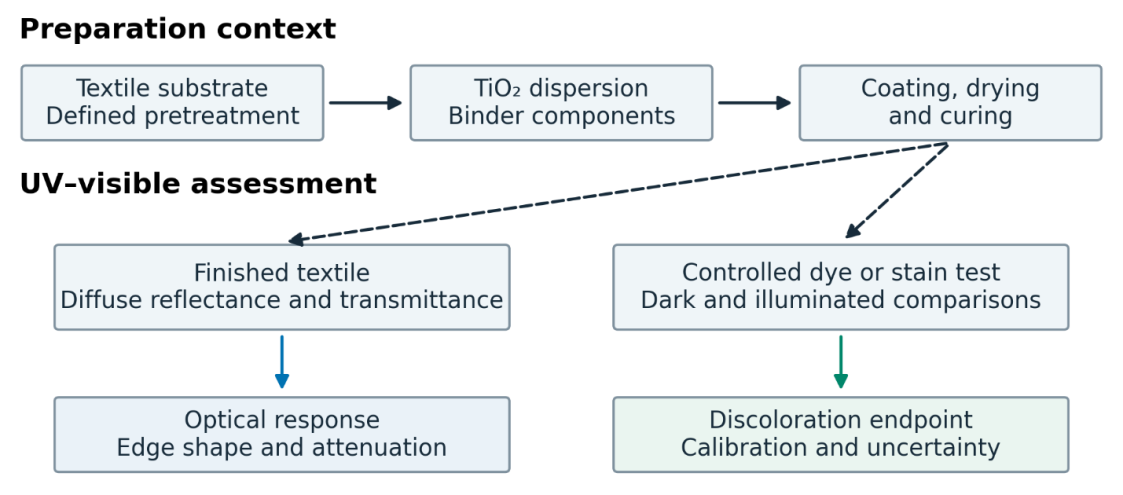
The absorbance data in UV–visible region of the samples doping of titanium dioxide with chitosan were analyzed with the aim of developing self-cleaning textiles based on titanium dioxide. This spectrum has 51 values spaced out 10 nm from 300 to 800 nm. All tabulated values are retained in comparison with no smoothing, normalization or removal of negative readings. The maximum tabulated values occur at 790 nm and are 0.117, 0.094r. The short-wavelength minima are −0.004, −0.005 and −0.005, respectively. The sudden increase from 780 to 790 nm needs to be confirmed before the long wavelength maximum can be attributed to a material transition. The measured comparison is read in conjunction with literature pertaining to optical geometry and dye photochemistry and textile coatings. The spectra define differences in reported optical response, but due to the limited record there is no definition of sample formulations or optical geometry/replicate variability. From these scans alone, the material-specific band gap, the photocatalytic activity and cleaning efficiency in the visible-light range can not be determined. There is still a need to perform controlled dye or stain measurements to relate the optical response to the self cleaning performance.
Downloads
References
[1] Fujishima A, Honda K. Electrochemical photolysis of water at a semiconductor electrode. Nature. 1972;238:37–38. https://doi.org/10.1038/238037a0
[2] Wang R, Hashimoto K, Fujishima A, Chikuni M, Kojima E, Kitamura A, Shimohigoshi M, Watanabe T. Light-induced amphiphilic surfaces. Nature. 1997;388:431–432. https://doi.org/10.1038/41233
[3] Daoud WA, Xin JH. Low temperature sol-gel processed photocatalytic titania coating. Journal of Sol-Gel Science and Technology. 2004;29:25–29. https://doi.org/10.1023/B:JSST.0000016134.19752.b4
[4] Daoud WA, Xin JH. Nucleation and growth of anatase crystallites on cotton fabrics at low temperatures. Journal of the American Ceramic Society. 2004;87(5):953–955. https://doi.org/10.1111/j.1551-2916.2004.00953.x
[5] Qi K, Daoud WA, Xin JH, Mak CL, Tang W, Cheung WP. Self-cleaning cotton. Journal of Materials Chemistry. 2006;16(47):4567–4574. https://doi.org/10.1039/B610861J
[6] Maity S, Tiwari S, Vishnoi P. Aqueous sol–gel nano-coating of titanium dioxide on cotton and silk fabrics for self-cleaning and UV protection finish. Fibers and Polymers. 2023;24:3183–3193. https://doi.org/10.1007/s12221-023-00293-7
[7] Ahmad I, Kan CW. Visible-light-driven, dye-sensitized TiO₂ photo-catalyst for self-cleaning cotton fabrics. Coatings. 2017;7(11):192. https://doi.org/10.3390/coatings7110192
[8] Ahmad I, Kan CW, Yao Z. Photoactive cotton fabric for UV protection and self-cleaning. RSC Advances. 2019;9(32):18106–18114. https://doi.org/10.1039/C9RA02023C
[9] Yan X, Ohno T, Nishijima K, Abe R, Ohtani B. Is methylene blue an appropriate substrate for a photocatalytic activity test? A study with visible-light responsive titania. Chemical Physics Letters. 2006;429(4–6):606–610. https://doi.org/10.1016/j.cplett.2006.08.081
[10] Mills A, Wang J. Photobleaching of methylene blue sensitised by TiO₂: an ambiguous system? Journal of Photochemistry and Photobiology A: Chemistry. 1999;127(1–3):123–134. https://doi.org/10.1016/S1010-6030(99)00143-4
[11] Mushtaq M. Photocatalytic self cleaning textile using titanium dioxide. Unpublished MPhil thesis manuscript. Faculty of Sciences, The Superior University, Lahore, Pakistan; n.d.
[12] Kubelka P. New contributions to the optics of intensely light-scattering materials. Part I. Journal of the Optical Society of America. 1948;38(5):448–457. https://doi.org/10.1364/JOSA.38.000448
[13] Makuła P, Pacia M, Macyk W. How to correctly determine the band gap energy of modified semiconductor photocatalysts based on UV–Vis spectra. The Journal of Physical Chemistry Letters. 2018;9(23):6814–6817. https://doi.org/10.1021/acs.jpclett.8b02892
[14] Tang H, Berger H, Schmid PE, Lévy F. Optical properties of anatase (TiO₂). Solid State Communications. 1994;92(3):267–271. https://doi.org/10.1016/0038-1098(94)90889-3
[15] Sclafani A, Herrmann JM. Comparison of the photoelectronic and photocatalytic activities of various anatase and rutile forms of titania in pure liquid organic phases and in aqueous solutions. The Journal of Physical Chemistry. 1996;100(32):13655–13661. https://doi.org/10.1021/jp9533584
[16] López R, Gómez R. Band-gap energy estimation from diffuse reflectance measurements on sol–gel and commercial TiO₂: a comparative study. Journal of Sol-Gel Science and Technology. 2012;61:1–7. https://doi.org/10.1007/s10971-011-2582-9
[17] Tauc J, Grigorovici R, Vancu A. Optical properties and electronic structure of amorphous germanium. physica status solidi (b). 1966;15(2):627–637. https://doi.org/10.1002/pssb.19660150224
[18] Viezbicke BD, Patel S, Davis BE, Birnie DP III. Evaluation of the Tauc method for optical absorption edge determination: ZnO thin films as a model system. physica status solidi (b). 2015;252(8):1700–1710. https://doi.org/10.1002/pssb.201552007
[19] Rochkind M, Pasternak S, Paz Y. Using dyes for evaluating photocatalytic properties: a critical review. Molecules. 2015;20(1):88–110. https://doi.org/10.3390/molecules20010088
[20] Pakdel E, Daoud WA. Self-cleaning cotton functionalized with TiO₂/SiO₂: focus on the role of silica. Journal of Colloid and Interface Science. 2013;401:1–7. https://doi.org/10.1016/j.jcis.2013.03.016
[21] Sakti LK, Eddy DR, Permana MD, Firdaus ML, Deawati Y, Rahayu I. Utilizing TiO₂ photocatalysis and natural SiO₂ superhydrophilicity synergy to improve self-cleaning activity in cotton fabric. Cellulose. 2024;31:5885–5898. https://doi.org/10.1007/s10570-024-05938-1
[22] Hoque MA, Guzman MI. Photocatalytic activity: experimental features to report in heterogeneous photocatalysis. Materials. 2018;11(10):1990.
Downloads
Published
License
Copyright (c) 2025 Maryam Mushtaq, Hafsa Mushtaq, Muhammad Waqar Anwar, Zahir hussain, Muhammad Nadeem Ahmad (Author)

This work is licensed under a Creative Commons Attribution 4.0 International License.
How to Cite