PREVALENCE OF LUMBER LORDOSIS AND POSTURAL MISALIGNMENT AMONG UNIVERSITY STUDENTS
DOI:
https://doi.org/10.71146/kjmr1011Keywords:
Lumbar lordosis, Postural misalignment, Postural balance, Spinal curvature, biomechanical phenomenaAbstract
Background of study: Lumbar lordosis and postural misalignment are increasingly prevalent musculoskeletal conditions among university students due to prolonged sitting, sedentary behavior, and excessive use of digital devices. Poor ergonomics and lack of physical activity further contribute to spinal deviations and muscle imbalance. These postural abnormalities can lead to low back pain, functional limitations, and reduced quality of life. Early identification and preventive strategies are essential to maintain spinal health and improve overall academic and physical wellbeing.
Methodology: A cross-sectional observational study was conducted at Indus University, Karachi, among 227 university students aged 18–25 years. Data were collected through a structured questionnaire and postural assessment using the plumb line method. Data were analyzed using SPSS, with descriptive statistics and Chi-square analysis applied at a significance level of p < 0.05.
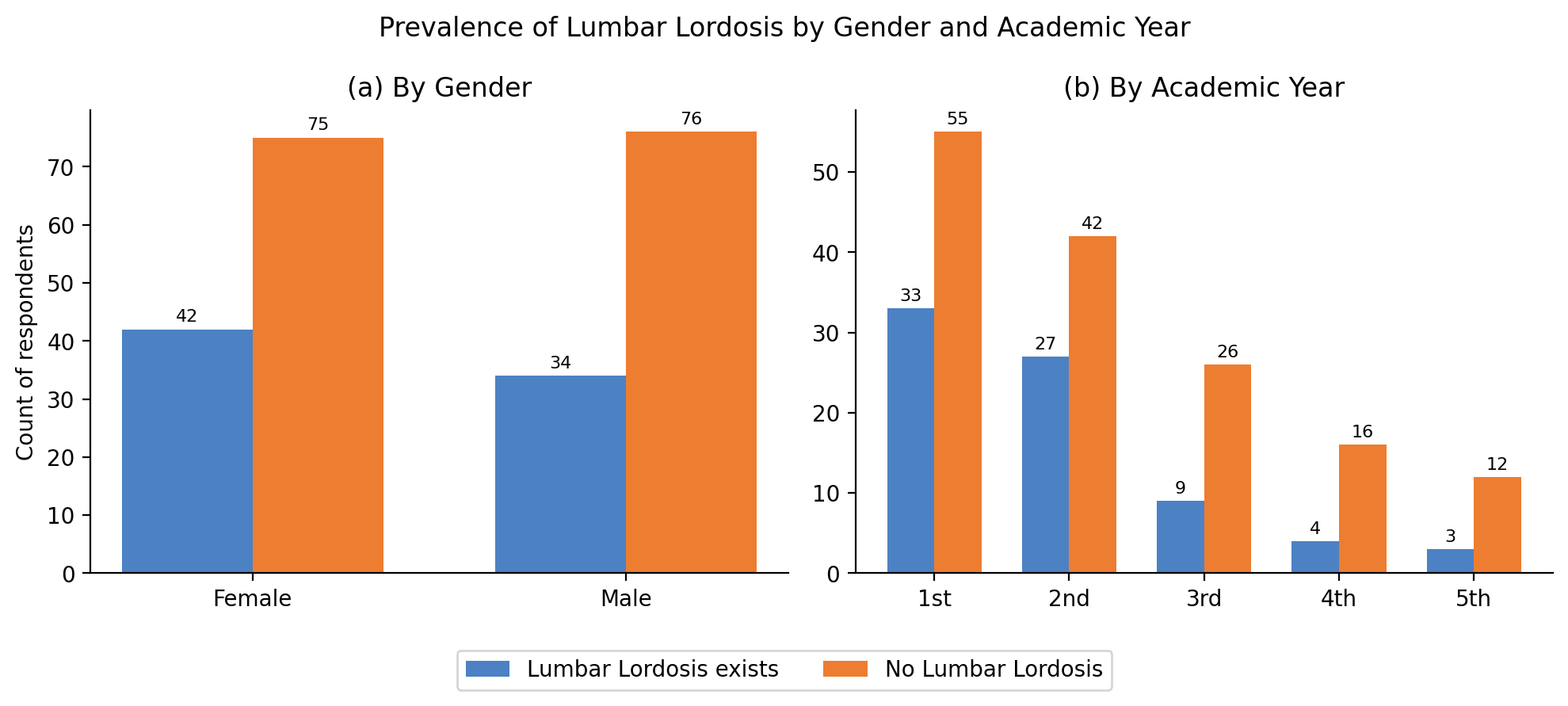
Results: Among 227 participants, lumbar lordosis was observed in 33.0%, while postural misalignment was present in 11.9%. Lumbar lordosis was slightly more prevalent among females, whereas postural misalignment was more common among males. A significant positive relationship was found between lumbar lordosis and postural misalignment (r = 0.287, p < 0.01). Chi-square analysis also showed a significant association between the two conditions (χ² = 18.73, p < 0.001).
Conclusion: Lumbar lordosis was more prevalent than postural misalignment among university students. The significant association between both conditions highlights the importance of early postural screening, ergonomic awareness, and physiotherapy interventions.
Downloads
References
1. Salsali M, Sheikhhoseini R, Sayyadi P, et al. Association between physical activity and body posture: a systematic review and meta-analysis. BMC Public Health. 2023; 23:1670.
2. Allam NM, Ebrahim HA, Megahed Ibrahim A, Elneblawi NH, El-Sherbiny M, Fouda KZ. The association of hamstring tightness with lumbar lordosis and trunk flexibility in healthy individuals. Front Bioeng Biotechnol. 2023; 11:1225973.
3. Ge T, Xie L, Li J, et al. Lumbar lordosis distribution in asymptomatic adult volunteers: a systematic review. HSS J. 2023;19(2):223–233.
4. Shen Y, Sardar ZM, Le Huec JC, et al. Variation in lumbar shape and lordosis in a large asymptomatic population. Spine (Phila Pa 1976). 2023;48(11):758–765.
5. Rajabi R, Bayattork M, et al. Normative values of lumbar lordosis curvature and its association with age, sex, and BMI. Asian Spine J. 2024;18(6):836–845.
6. Alwashmi AH. Prevalence of low back pain and associated factors among university students. Cureus. 2023;15(9):e44596.
7. Mirbagheri SS, Rahmani-Rasa A, Farmani F, et al. Evaluating kyphosis and lordosis in students and their relationship with spinal pain. Asian Spine J. 2015;9(3):416–422.
8. Wiraputri AAW, Wardana ING, Widianti IG, Muliani M. Prevalence of lumbar hyperlordosis in university students. E-Jurnal Medika Udayana. 2022;11(5):101–107.
9. Ergonomic posture and spinal alignment studies in young adults. Int J Environ Res Public Health. 2023;20(24):7191.
10. Smartphone use and postural changes in adolescents and young adults: systematic review. 2023.
11. Forward head posture and spinal alignment in digital device users. Ergonomic studies 2022–2024.
12. Sedentary lifestyle and musculoskeletal disorders in university students. BMC Musculoskelet Disord. 2023; 24:455.
13. Mirbagheri SS, Rahmani-Rasa A, Farmani F, Amini P, Nikoo MR. Evaluation of forward head posture and related ergonomic factors among university students. J Bodyw Mov Ther. 2021;25:93–99.
14. Wiraputri AAW, Wardana ING, Widianti IG, Muliani M. The relationship between sedentary behavior and postural abnormalities among university students. J Public Health Res. 2022;11(2):215–221.
15. Alwashmi AH. The impact of psychological stress on musculoskeletal health and posture among students. Healthcare (Basel). 2023;11(4):512.
16. Allam NM, Ebrahim HA, Megahed Ibrahim A, Elneblawi NH, El-Sherbiny M, Fouda KZ. Effect of core stability exercises on postural alignment and musculoskeletal function in young adults. Bull Fac Phys Ther. 2022;27(1):34.
17. Park JH, Kim JH, Lee NK. Effects of physiotherapy interventions on postural correction and spinal alignment in university students. J Phys Ther Sci. 2020;32(8):505–510.
18. Shen Y, Sardar ZM, Le Huec JC, et al. Screening and assessment methods for postural deformities in adolescents and young adults: A review. Eur Spine J. 2021;30(5):1123–1132.
19. Rodrigues MS, Carvalho AR, Silva AG, et al. Prevalence and associated factors of postural deviations among university students: A cross-sectional study. BMC Musculoskelet Disord. 2022;23:456.
20. Ge T, Xie L, Li J, Wang Y, Zhang C. Effectiveness of physiotherapy interventions for postural correction: A systematic review and meta-analysis. Physiotherapy Theory Pract. 2023;39(7):1284–1298.
Downloads
Published
License
Copyright (c) 2026 Husnain Murtaza, Asma Batool, Okasha Anjum (Author)

This work is licensed under a Creative Commons Attribution 4.0 International License.
How to Cite