THE IMPACT OF AUTONOMOUS AI AGENTS ON PRODUCT DISCOVERY EFFICIENCY IN DIGITAL PRODUCT TEAMS
DOI:
https://doi.org/10.71146/kjmr1010Keywords:
Autonomous AI agents, product discovery efficiency, digital product teams, team-AI collaboration, data quality, organisational AI readiness, reproducibility, model validationAbstract
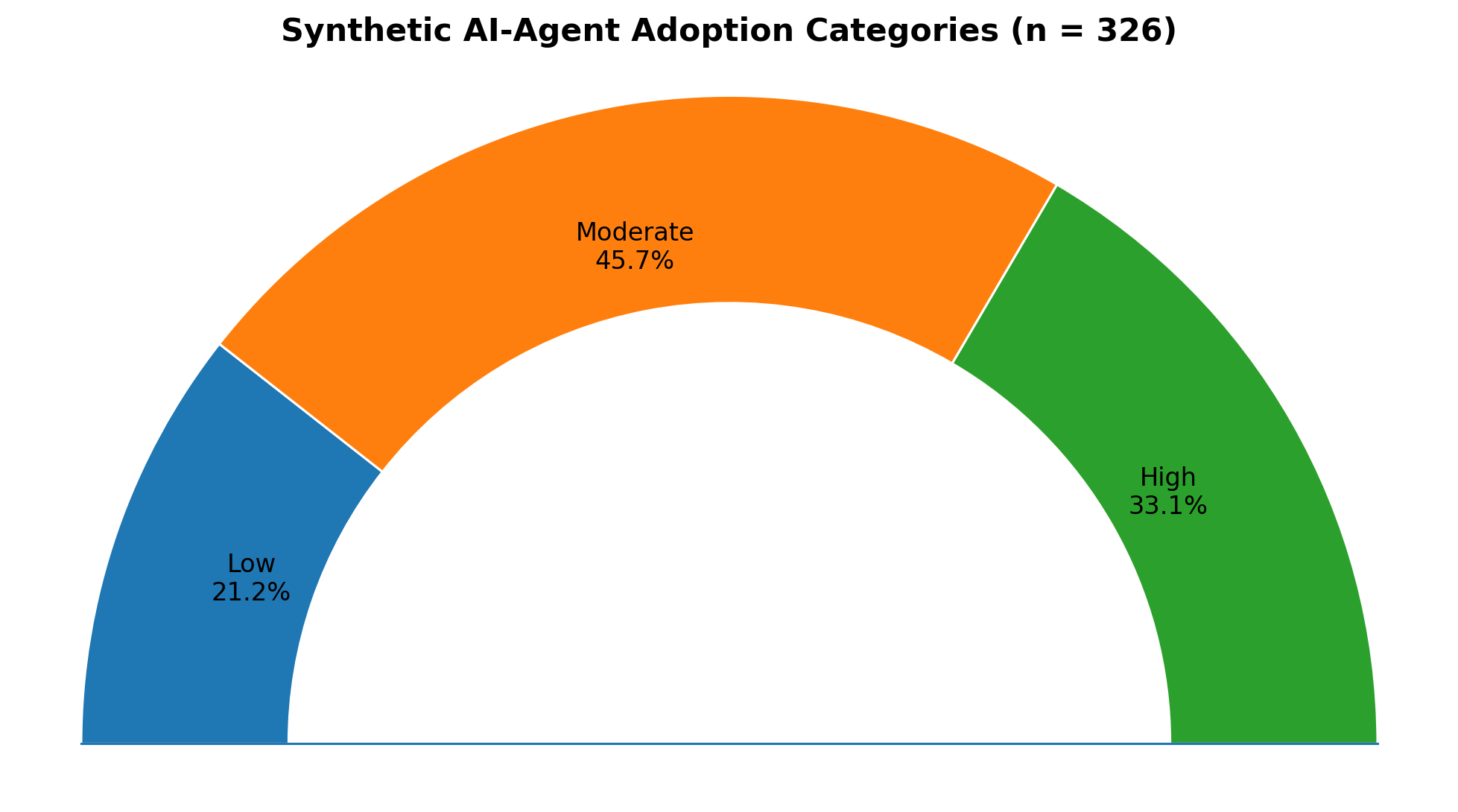
This paper develops and reproducibly demonstrates a structural model that examines how the use of autonomous AI agents may influence product discovery efficiency in digital product teams. The model considers direct relationships with product discovery efficiency, discovery speed, and customer-insight quality; the mediating role of team-AI collaboration; the moderating roles of data quality, task complexity, organisational AI readiness, and product-team maturity; and the negative association of perceived AI risk with agent use. A positivist, deductive, quantitative, constructed-data model-validation design was implemented through a fully documented Python pipeline with a fixed random seed of 42. An initial pool of 400 professional profiles was generated; after a programmed eligibility stage and transparent screening for incomplete and uniform-response patterns, 326 cases were retained. Reflective construct scores were analysed using loading-weighted composites, standardized path models, and 5,000 nonparametric bootstrap resamples. Autonomous AI-agent use was positively associated with product discovery efficiency (beta = 0.173), discovery speed (beta = 0.331), customer-insight quality (beta = 0.346), and team-AI collaboration (beta = 0.510). Team-AI collaboration partially mediated the relationship between AAU and PDE (indirect beta = 0.180; VAF = 42.8%). Data quality, task complexity, and organisational AI readiness significantly moderated the AAU-PDE relationship in the hypothesised directions, whereas product-team maturity did not (beta = 0.080; 95% CI [-0.034, 0.204]). Perceived AI risk was negatively associated with AI-agent use (beta = -0.354). These results demonstrate the internal, reproducible behaviour of a researcher-specified simulation model and are not empirical estimates of real organisations.
Downloads
References
Abou Ali, M., Dornaika, F., & Charafeddine, J. (2026). Agentic AI: A comprehensive survey of architectures, applications, and future directions. Artificial Intelligence Review, 59, Article 11. https://doi.org/10.1007/s10462-025-11422-4
Bostrom, R. P., & Heinen, J. S. (1977). MIS problems and failures: A socio-technical perspective. Part I: The causes. MIS Quarterly, 1(3), 17–32. https://doi.org/10.2307/248710
Bouschery, S. G., Blazevic, V., & Piller, F. T. (2023). Augmenting human innovation teams with artificial intelligence: Exploring transformer-based language models. Journal of Product Innovation Management, 40(2), 139–153. https://doi.org/10.1111/jpim.12656
Brynjolfsson, E., Li, D., & Raymond, L. R. (2025). Generative AI at work. The Quarterly Journal of Economics, 140(2), 889–942. https://doi.org/10.1093/qje/qjae044
Cooper, R. G. (2024). The artificial intelligence revolution in new-product development. IEEE Engineering Management Review, 52(1), 195–211. https://doi.org/10.1109/EMR.2023.3336834
Dell’Acqua, F., McFowland, E., III, Mollick, E., Lifshitz, H., Kellogg, K. C., Rajendran, S., Krayer, L., Candelon, F., & Lakhani, K. R. (2026). Navigating the jagged technological frontier: Field experimental evidence of the effects of artificial intelligence on knowledge worker productivity and quality. Organization Science, 37(2), 403–423. https://doi.org/10.1287/orsc.2025.21838
Doshi, A. R., & Hauser, O. P. (2024). Generative AI enhances individual creativity but reduces the collective diversity of novel content. Science Advances, 10(28), Article eadn5290. https://doi.org/10.1126/sciadv.adn5290
Fügener, A., Grahl, J., Gupta, A., & Ketter, W. (2022). Cognitive challenges in human–artificial intelligence collaboration: Investigating the path toward productive delegation. Information Systems Research, 33(2), 678–696. https://doi.org/10.1287/isre.2021.1079
Gama, F., & Magistretti, S. (2025). Artificial intelligence in innovation management: A review of innovation capabilities and a taxonomy of AI applications. Journal of Product Innovation Management, 42(1), 76–111. https://doi.org/10.1111/jpim.12698
Goodhue, D. L., & Thompson, R. L. (1995). Task-technology fit and individual performance. MIS Quarterly, 19(2), 213–236. https://doi.org/10.2307/249689
Knudsen, M. P., von Zedtwitz, M., Griffin, A., & Barczak, G. (2023). Best practices in new product development and innovation: Results from PDMA’s 2021 global survey. Journal of Product Innovation Management, 40(3), 257–275. https://doi.org/10.1111/jpim.12663
Lebovitz, S., Lifshitz-Assaf, H., & Levina, N. (2022). To engage or not to engage with AI for critical judgments: How professionals deal with opacity when using AI for medical diagnosis. Organization Science, 33(1), 126–148. https://doi.org/10.1287/orsc.2021.1549
Mariani, M., & Dwivedi, Y. K. (2024). Generative artificial intelligence in innovation management: A preview of future research developments. Journal of Business Research, 175, Article 114542. https://doi.org/10.1016/j.jbusres.2024.114542
National Institute of Standards and Technology. (2024). Artificial intelligence risk management framework: Generative artificial intelligence profile (NIST AI 600-1). U.S. Department of Commerce. https://doi.org/10.6028/NIST.AI.600-1
Noy, S., & Zhang, W. (2023). Experimental evidence on the productivity effects of generative artificial intelligence. Science, 381(6654), 187–192. https://doi.org/10.1126/science.adh2586
Park, J. S., O’Brien, J. C., Cai, C. J., Morris, M. R., Liang, P., & Bernstein, M. S. (2023). Generative agents: Interactive simulacra of human behavior. In Proceedings of the 36th Annual ACM Symposium on User Interface Software and Technology (Article 2, pp. 1–22). Association for Computing Machinery. https://doi.org/10.1145/3586183.3606763
Qian, C., Liu, W., Liu, H., Chen, N., Dang, Y., Li, J., Yang, C., Chen, W., Su, Y., Cong, X., Xu, J., Li, D., Liu, Z., & Sun, M. (2024). ChatDev: Communicative agents for software development. In Proceedings of the 62nd Annual Meeting of the Association for Computational Linguistics (Vol. 1, pp. 15174–15186). Association for Computational Linguistics. https://doi.org/10.18653/v1/2024.acl-long.810
Rasheed, Z., Waseem, M., Sami, M. A., Kemell, K.-K., Ahmad, A., Duc, A. N., Systä, K., & Abrahamsson, P. (2025). Autonomous agents in software development: A vision paper. In Agile processes in software engineering and extreme programming—Workshops (pp. 15–23). Springer. https://doi.org/10.1007/978-3-031-72781-8_2
Schäper, T., Foege, J. N., & Nüesch, S. (2024). Toolkits for innovation: How digital technologies empower users in new product development. R&D Management, 54(1), 95–117. https://doi.org/10.1111/radm.12642
Vaccaro, M., Almaatouq, A., & Malone, T. W. (2024). When combinations of humans and AI are useful: A systematic review and meta-analysis. Nature Human Behaviour, 8, 2293–2303. https://doi.org/10.1038/s41562-024-02024-1
Wang, L., Ma, C., Feng, X., Zhang, Z., Yang, H., Zhang, J., Chen, Z., Tang, J., Chen, X., Lin, Y., Zhao, W. X., Wei, Z., & Wen, J. (2024). A survey on large language model based autonomous agents. Frontiers of Computer Science, 18, Article 186345. https://doi.org/10.1007/s11704-024-40231-1
Wu, S., Liu, Y., Ruan, M., Chen, S., & Xie, X.-Y. (2025). Human-generative AI collaboration enhances task performance but undermines human’s intrinsic motivation. Scientific Reports, 15, Article 15105. https://doi.org/10.1038/s41598-025-98385-2
Downloads
Published
Issue
Section
Categories
License
Copyright (c) 2026 Fahad Abdullah (Author)

This work is licensed under a Creative Commons Attribution 4.0 International License.
How to Cite