PRIVATE 5G LAN ARCHITECTURE FOR INDUSTRIAL IOT SURVEILLANCE IN SUBSURFACE MINING
DOI:
https://doi.org/10.71146/kjmr1008Keywords:
5G Private Network, Internet of Things (IoT), Mine Remote Monitoring, Multi-Source Data Fusion, Depth Network SlicingAbstract
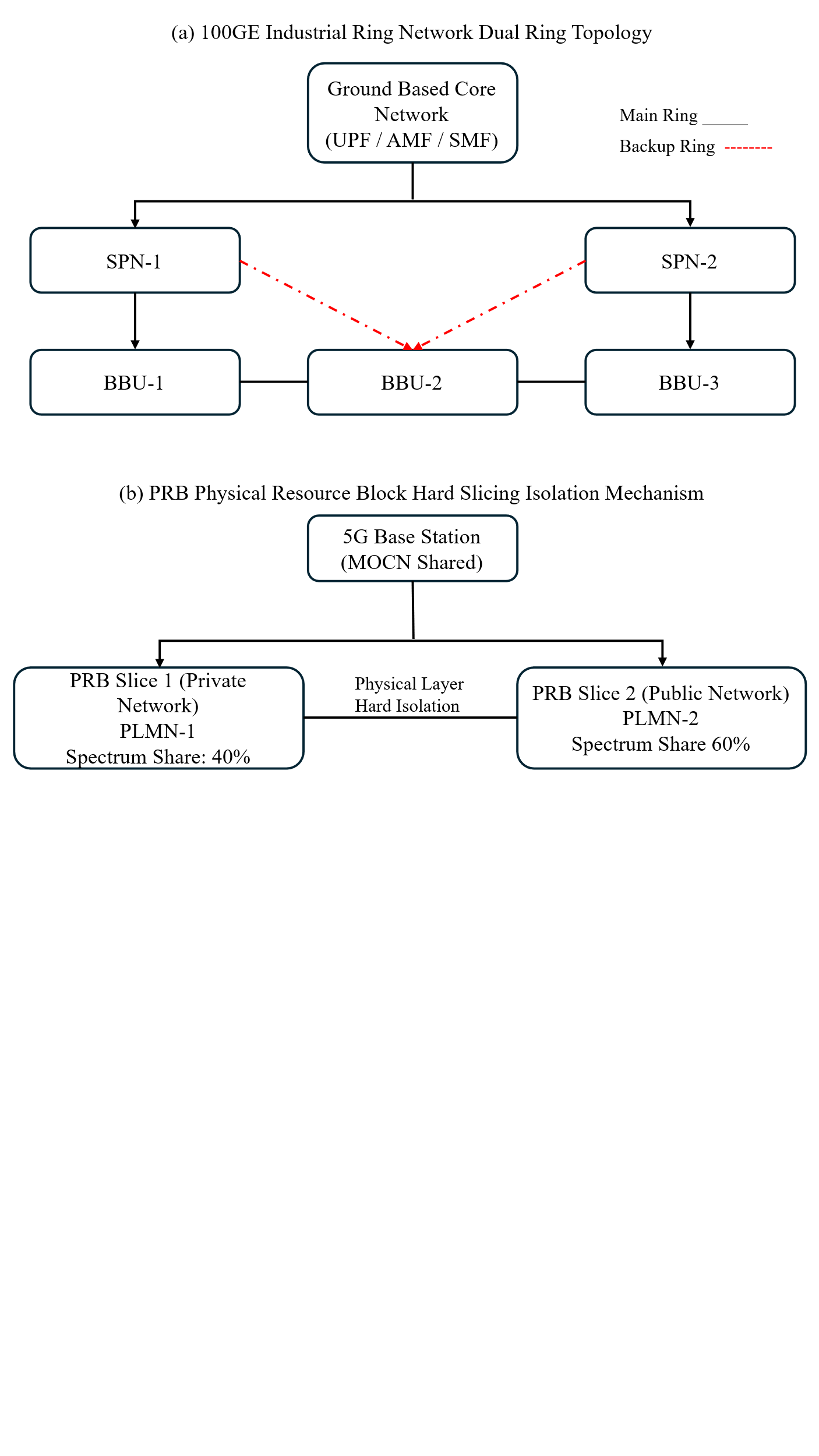
To address the high transmission latency, low multi-source data fusion efficiency, and difficulty of managing widely distributed terminal devices in mine remote-monitoring systems, this paper builds an optimized architecture that integrates 5G and the Internet of Things (IoT). The core network is deployed in Standalone Architecture (SA) mode, and 5G network slicing combined with Physical Resource Block (PRB)-level scheduling achieves hard spectrum isolation between public- and private-network traffic. A 100GE industrial ring network together with dual-band (2.6 GHz and 700 MHz) base stations provides coordinated coverage of the underground work area, and a multi-source heterogeneous data fusion algorithm combining the 3σ criterion with a dual-threshold identification method is designed to improve data quality. Field trial results show that, across underground roadways totaling 36,000 m, the optimized system holds end-to-end transmission latency stably within 25–30 ms, achieves an overall system availability of 98.7%, reduces overall equipment failure rate by 40%, achieves underground personnel positioning accuracy of 5 m, and cuts the fault emergency-response time to 8 min. The measured results fully validate the effectiveness and engineering practicality of optimized architecture.
Downloads
References
[1] H. Zhang, "5G private local area network scenarios and solutions," in 5G Private Mobile Networks: Architectures, Technologies, and Applications, Springer, 2024, pp. 115–138, doi: 10.1007/978-981-97-8453-0_6.
[2] C.-X. Wang et al., "On the road to 6G: Visions, requirements, key technologies, and testbeds," IEEE Commun. Surv. Tutor., vol. 25, no. 2, pp. 905–974, 2nd Quart., 2023, doi: 10.1109/COMST.2023.3249835.
[3] D. Sharma, V. Tilwari, and S. Pack, "An overview for designing 6G networks: Technologies, spectrum management, enhanced air interface, and AI/ML optimization," IEEE Internet Things J., vol. 12, no. 6, pp. 6133–6157, Mar. 2025, doi: 10.1109/JIOT.2024.3505617.
[4] G. Wang et al., "Development path of intelligent, safe, green coal mining and clean, efficient utilization technology," Int. J. Coal Sci. Technol., vol. 13, no. 1, p. 66, Jun. 2026, doi: 10.1007/s40789-025-00854-6.
[5] M. Malik, A. Kothari, and R. A. Pandhare, "Stand alone or non stand alone 5G tactical edge network architecture for military and use case scenarios," in Proc. IEEE Int. Conf. Intell. Signal Process. Effective Commun. Technol. (INSPECT), Dec. 2024, pp. 1–6, doi: 10.1109/INSPECT63485.2024.10896152.
[6] D. A. Milovanovic, Z. S. Bojkovic, and T. P. Fowdur, "5G-Advanced mobile communication: New concepts and research challenges," in Driving 5G Mobile Communications with Artificial Intelligence Towards 6G, D. A. Milovanovic and Z. S. Bojkovic, Eds. Boca Raton, FL, USA: CRC Press, 2023, pp. 1–28.
[7] E. Gures, I. Shayea, A. Alhammadi, M. Ergen, and H. Mohamad, "A comprehensive survey on mobility management in 5G heterogeneous networks: Architectures, challenges and solutions," IEEE Access, vol. 8, pp. 195883–195913, 2020, doi: 10.1109/ACCESS.2020.3030762.
[8] T. Bouzid, N. Chaib, M. L. Bensaad, and O. S. Oubbati, "5G network slicing with unmanned aerial vehicles: Taxonomy, survey, and future directions," Trans. Emerg. Telecommun. Technol., vol. 34, no. 3, p. e4721, Mar. 2023, doi: 10.1002/ett.4721.
[9] A. Guidotti, T. De Cola, R. Campana, A. Vanelli-Coralli, and S. Scalise, "Non-terrestrial networks: An evolution toward 3D networks," in Non-Terrestrial Networks, M. Z. Shakir and A. Kaushik, Eds. London, UK: Academic Press, 2026, ch. 4, pp. 95–122, doi: 10.1016/B978-0-443-26526-6.00010-4.
[10] A. Mozo, S. Vakaruk, J. E. Sierra-García, and A. Pastor, "Anticipatory analysis of AGV trajectory in a 5G network using machine learning," J. Intell. Manuf., vol. 35, no. 4, pp. 1541–1569, Apr. 2024, doi: 10.1007/s10845-023-02116-1.
[11] J. Li et al., "Wide antenna bandwidth Y-type ferrite-based composites for 5G communication applications," Ceram. Int., vol. 52, no. 14, pt. B, pp. 25435–25447, Jun. 2026, doi: 10.1016/j.ceramint.2026.04.125.
[12] A. N. Obead and N. A. Ali, "Pulsed laser deposition of nano-silver supercharges polypyrrole/carbon black for effective electromagnetic shielding," J. Mater. Sci.: Mater. Electron., vol. 37, no. 15, p. 1196, May 2026, doi: 10.1007/s10854-026-17593-2.
[13] A. Amaro et al., "Determination of electromagnetic shielding effectiveness using an enhanced Absorber Box method: Theoretical, simulation, and experimental approaches," Meas. Sci. Technol., vol. 36, no. 7, p. 076003, Jun. 2025, doi: 10.1088/1361-6501/ade55a.
[14] C. Zhang, G. Zhou, J. Li, F. Chang, K. Ding, and D. Ma, "A multi-access edge computing enabled framework for the construction of a knowledge-sharing intelligent machine tool swarm in Industry 4.0," J. Manuf. Syst., vol. 66, pp. 56–70, Feb. 2023, doi: 10.1016/j.jmsy.2022.11.015.
[15] P. Mach and Z. Becvar, "On the edge of the deployment: A survey on multi-access edge computing," ACM Comput. Surv., vol. 54, no. 11s, art. 238, pp. 1–35, Dec. 2022, doi: 10.1145/3529758.
[16] D. Zhang, W. Shi, and X. Jia, "Exploring scientific principles and laws of artificial intelligence, world model, and artificial general intelligence (AGI) in future intelligence networking: Paradigms, architectures, and innovations," IEEE Commun. Surv. Tutor., vol. 28, pp. 5456–5495, 2026, doi: 10.1109/COMST.2026.3672428.
[17] M. I. Khattak, H. Yuan, A. Khan, A. Ahmad, I. Ullah, and M. Ahmed, "Evolving multi-access edge computing (MEC) for diverse ubiquitous resources utilization: A survey," Telecommun. Syst., vol. 88, no. 2, p. 71, May 2025, doi: 10.1007/s11235-025-01310-1.
[18] Y. Yu et al., "An overview of compute first networking," Int. J. Web Grid Serv., vol. 17, no. 2, pp. 118–137, 2021, doi: 10.1504/IJWGS.2021.114566.
Downloads
Published
License
Copyright (c) 2026 Qifan Shen, Qirong Shen, Lei Sun, Sihan Shen, Yutong Ye, Muhammad Wahab Hanif (Author)

This work is licensed under a Creative Commons Attribution 4.0 International License.
How to Cite